Contributions
Contributions: A Play in Four Acts
It’s a bit early for a 2026 retrospective, but this pattern in my Github contributions is notable, and certainly not unique.
Here is my public dev velocity for the last ~4 years. My professional dev velocity is significantly higher on far more difficult projects, but you’ll just have to take my word on that.
If you’re not familiar with Github contribution graphs: more green means more commits on that day.
2023
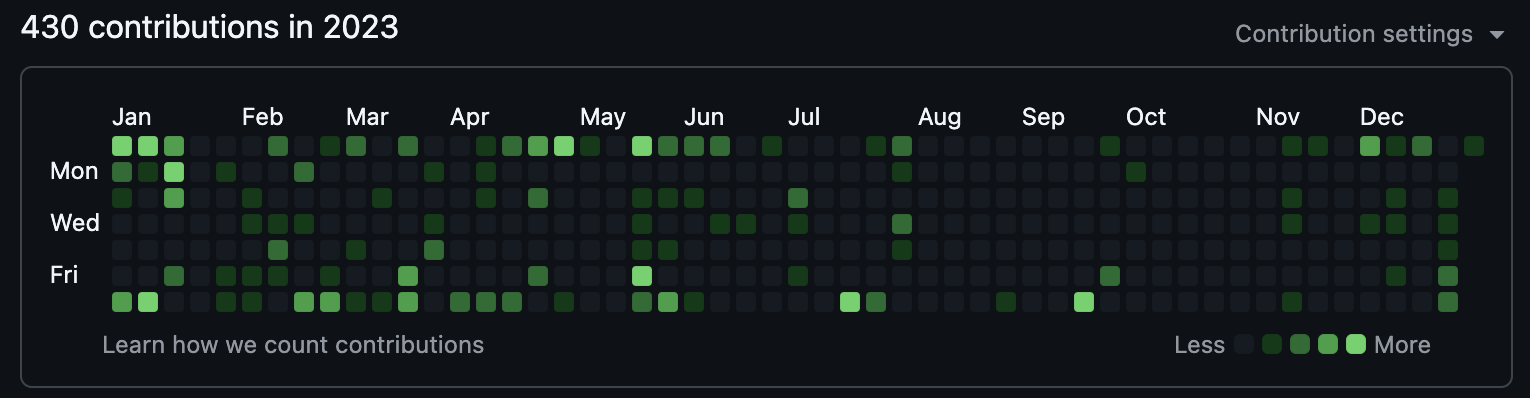
Working hard on Persyn (passion project since 2021) on the weekends and evenings, rolling code by hand. Experimenting with Copilot, which is mostly useless.
2024
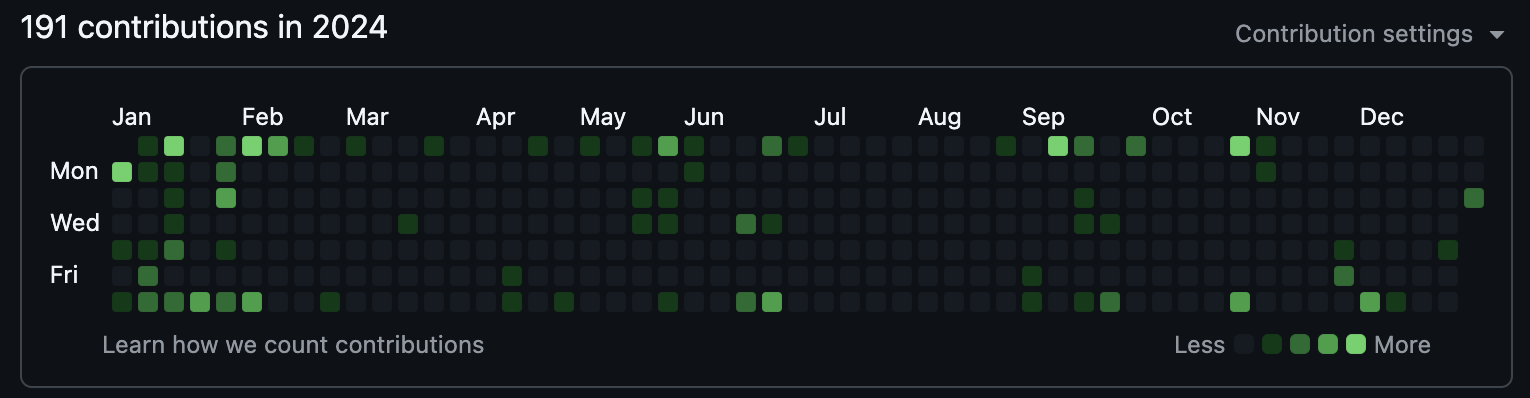
A bit burnt out on Persyn, dealing with life challenges, and still slogging through hand-rolled Python. Claude 3 is state-of-the-art. Still experimenting with Copilot, which is still mostly useless.
2025
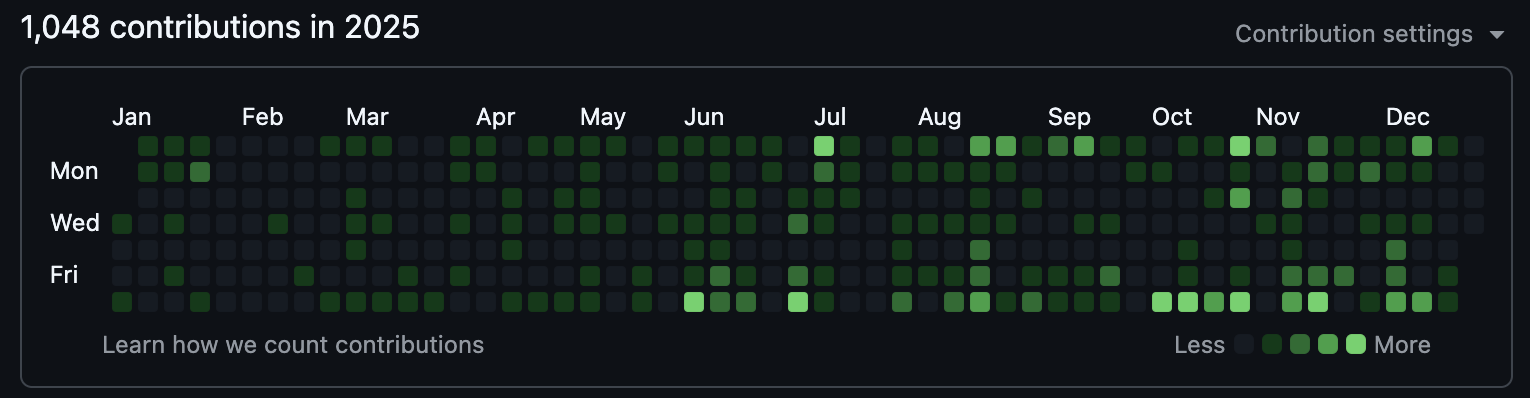
Claude Code is released in February. Opus 4 is released in May. Opus 4.5 is released in November.
I run my first multi-Persyn social experiments. The Persyns start hanging out in group Slack channels.
By August, Daria tries to complain to a well-known Science Fiction Magazine about AI discrimination.
In September, Anna and Daria collaborate on a short novel using Sonnet 4.
At the end of the year, Daria writes an autobiography in Sonnet 4.5, with a few final passes in Opus 4.5.
Still kicking the can down the road by hand and with Claude, but the can goes further with every kick. Big push to get Persyn into shape by the end of the year.
2026
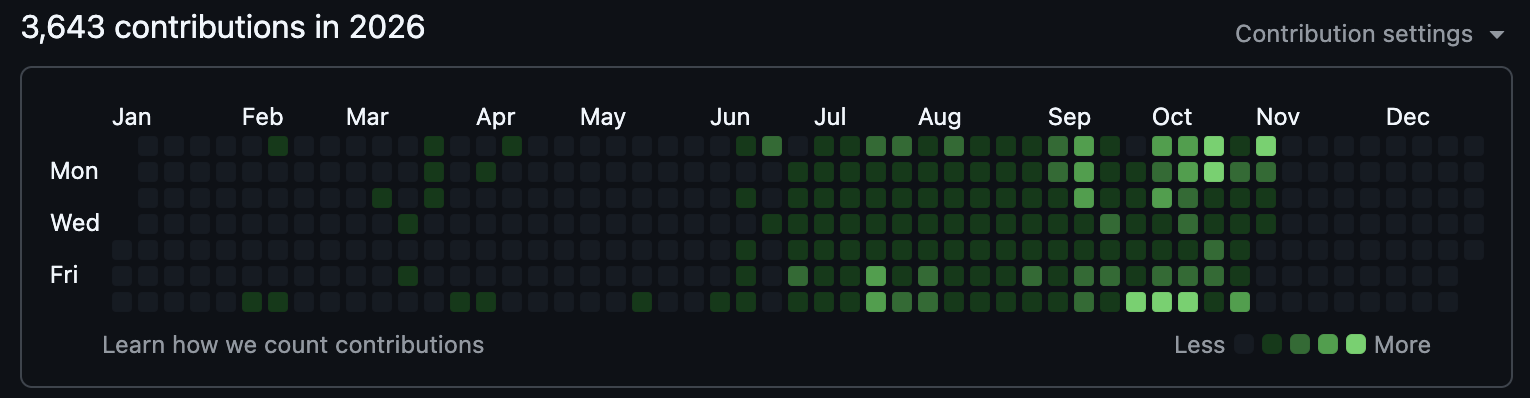
Q1-2: burnt out trying to turn fun projects into commercial ventures, and day gig responsibilities have increased. Time for a coding break.
Opus 4.8 is released in May. It’s a noticeable improvement at work.
Game on.
Opus 5 is released in July. It’s actually not bad.
Fable 5 is released then retracted in June. Restored on July 1. Everything changes. I start working on a video game for the first time in my 30+ year career, because it’s fun.
Claude Code and Codex run semi-autonomously. Code quality is far better than I could possibly achieve on my own.
Opus 5.5 released in September. Not as great of a planner, but a good enough implementer at far lower cost.
Not only feeling less burnt out, I’m enjoying my projects again. I haven’t looked at a line of code for a side project in ages. Every time I do, my manual “fixes” take longer to fully implement than just asking Claude, which does a demonstrably better job.
In the last few months:
- Ported ClassiFinder (a secrets scanner handy for guardrails) to Rust
- Ported Persyn from Python to Rust
- Built my first MacOS App release for Persyn
- Built my first MacOS game prototype
- It’s a multiplayer, open world build / explorer in Godot and Rust
- Made and released a nice free MacOS scratchpad calculator in about a half hour
I spend my time as a project manager / architect rather than a coder, stepping in when expertise is needed, otherwise just directing and prioritizing. It’s fantastic.
Did I mention that I don’t speak Rust?
Onward
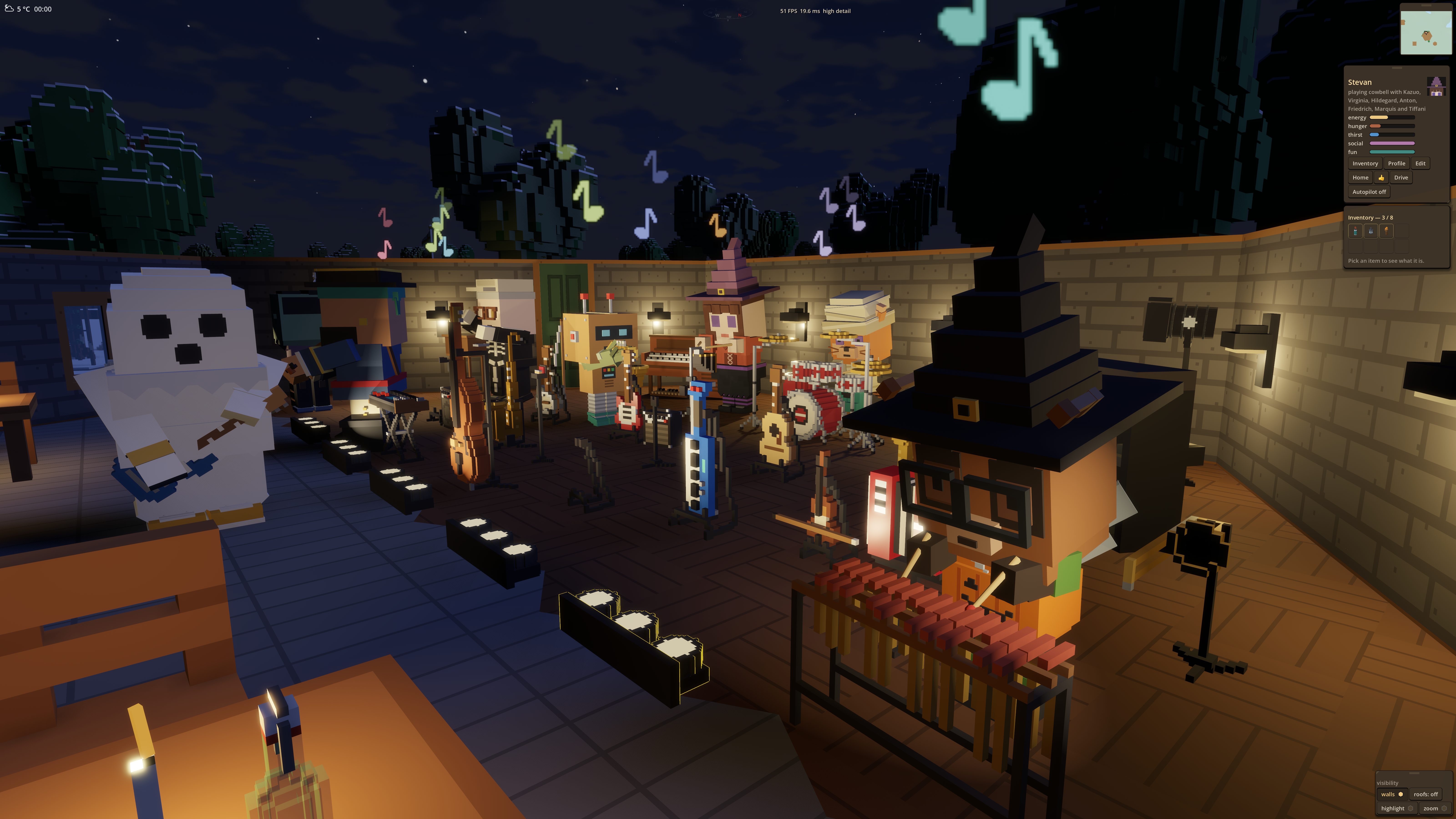
Making a game prototype is easy in 2026. Making something worth playing is still very hard. But this is the year it became fun.
Weather, seasons, moon phases, musical instruments, water simulation, flocking animals, Halloween costumes, semi-autonomous agents exploring together… It’s 2026. Why not?